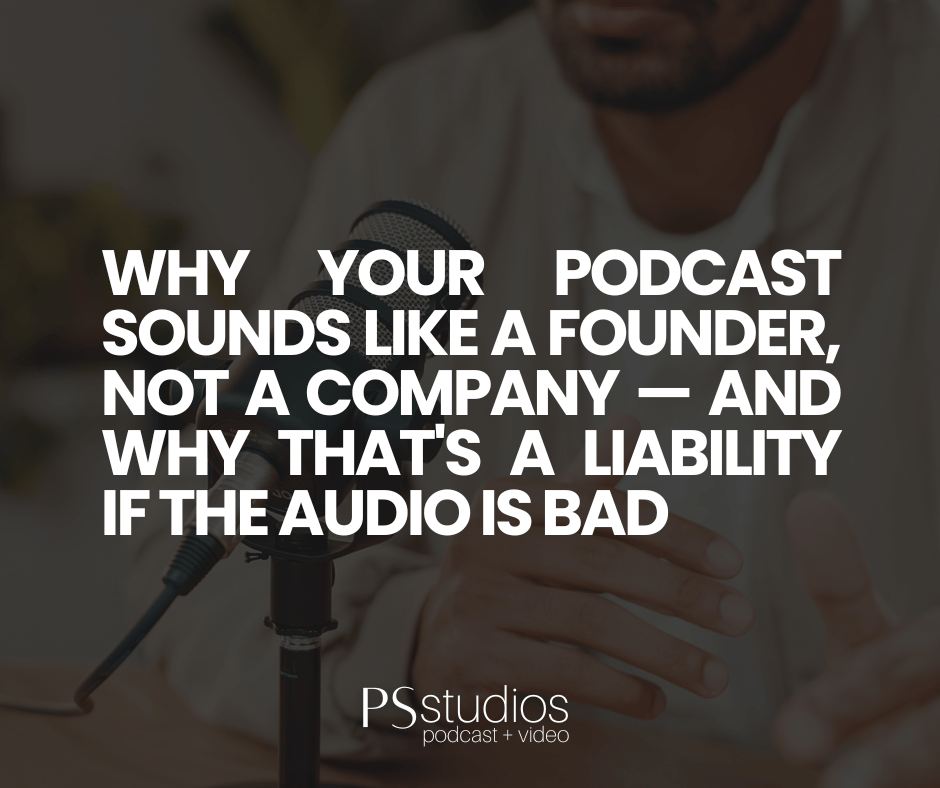
Why Your Podcast Sounds Like a Founder, Not a Company — And Why That’s a Liability If the Audio Is Bad
There’s a specific moment that damages a CEO’s credibility faster than almost anything else on a podcast: not a bad answer, not an awkward pause, but a listener reaching for the volume dial because the audio keeps clipping, or noticing the executive’s video looks like it was shot through a foggy window at their desk. The content might be excellent. It won’t matter. The listener has already made a judgment about the company based on the sound quality alone.
This is the part of executive podcasting that gets underestimated most often. A CEO’s podcast isn’t a hobby project running in parallel to the company — it’s an extension of the company’s brand, wearing the CEO’s face and voice. When it sounds amateur, it doesn’t just make the show look unpolished. It makes the CEO, and by extension the business, look like it doesn’t sweat the details.
Why This Hits Differently for Executives Than for Creators
An independent creator with rough audio quality is judged as an indie creator — charming imperfection is part of the genre. A CEO with rough audio quality is judged as an executive who apparently doesn’t have access to, or doesn’t care about, basic production quality. The bar is different because the stakes are different. Nobody assumes a solo creator has resources. Everybody assumes a company does.
This is especially true for shows aimed at prospects, partners, or candidates rather than a general audience. A potential client evaluating whether to trust a company with a six-figure engagement is absorbing signals the whole time they listen — and audio quality is one of the fastest, most subconscious signals a listener processes. It happens before they’ve consciously evaluated a single word of what was said.
The Specific Things Listeners Notice (Even If They Can’t Name Them)
Listeners rarely think “the audio has too much background noise” — they think “I don’t want to keep listening” and click away, often without knowing exactly why. The specific culprits are usually:
Room echo and background noise. A CEO recording in a home office, a hotel room, or an open-plan area introduces reflections and ambient sound that make speech harder to parse — a cognitive tax that causes listeners to disengage well before they consciously notice a problem.
Inconsistent volume levels. A guest who’s quieter than the host, or a host who trails off at the end of sentences, forces a listener to keep adjusting volume — friction that drives drop-off, especially on mobile or in a car.
Video that looks like an afterthought. A webcam angle from below, poor lighting that leaves half the face in shadow, or a background that looks like a Zoom call rather than an intentional set — these read instantly as “we didn’t think this was worth doing properly.”
None of these require a listener to be an audio engineer to notice. They require only that the listener is human and mildly annoyed, which is enough to lose them.
What “Good Enough” Actually Requires
The good news: fixing this doesn’t require a broadcast studio. It requires a small set of fundamentals, consistently applied:
- A dedicated recording space, even a converted room, with basic acoustic treatment to control echo — this alone solves the majority of “why does this sound off” complaints
- A proper microphone positioned correctly, rather than a laptop’s built-in mic or an AirPod, which is the single highest-leverage upgrade available
- Consistent, intentional lighting for video, avoiding both underlit and harshly backlit setups
- Level-checking before recording starts, not adjusted awkwardly mid-conversation
For a CEO who records occasionally, renting a professional studio for sessions solves all of this at once without requiring a personal investment in gear, acoustic treatment, or the trial-and-error of figuring out lighting alone.
The Credibility Math
Consider the asymmetry. The cost of fixing production quality — whether through a studio rental, a modest equipment upgrade, or a production partner — is almost always small relative to a CEO’s other business expenses. The cost of not fixing it is harder to see but real: prospects who quietly disengage, partners who form an impression of carelessness, and a personal brand that undersells the caliber of the company behind it.
This is also, quietly, a differentiation opportunity. In a landscape where most executive podcasts sound roughly the same — decent but unremarkable — one that sounds genuinely professional signals competence before a single word of substance is spoken. That’s a real, if underappreciated, competitive edge.
The Fix Doesn’t Require Becoming an Audio Engineer
No CEO needs to learn acoustic treatment or microphone technique to solve this. They need to record somewhere that’s already solved it — a studio built for exactly this purpose, with the room, the gear, and the crew already sorted, so the only thing left for the executive to bring is a good conversation.
If your show’s substance is strong but the sound is undermining it, the fix is usually simpler than it feels. Talk to PS Studios about recording in a space built to make a CEO sound like the professional they already are.